
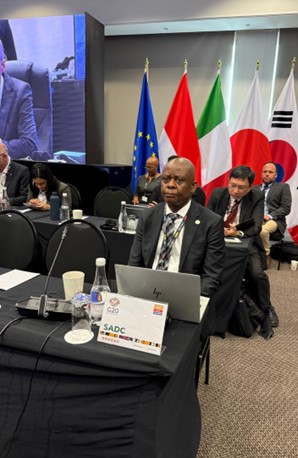
The G20 Agriculture Working Group and Food Security Task Force held back-to-back Ministerial meetings on September 18–19, 2025, under South Africa’s G20 Presidency. The events, hosted in Somerset West, marked a decisive shift in placing agriculture and food systems at the heart of global policy debates, with strong emphasis on inclusivity, resilience, and data-driven solutions.
The Agriculture Working Group meeting, themed “Data-Driven Approaches to Addressing Food Security and Promoting Inclusive Agricultural Investment and Market Access”, highlighted six key priorities: integrating agriculture centrally in G20 policy, empowering smallholders—especially women and youth—leveraging digital innovation, boosting climate resilience, improving market transparency, and driving evidence-based policy.
South African Minister John Steenhuisen emphasised the importance of aligning global agricultural policies with the real needs of farmers and consumers, citing South Africa’s own use of blended finance and technology transfer as a model.
Technology and innovation featured prominently, with calls for expanded research into drought-tolerant crops, enhanced soil and water management, and stronger digital systems to improve market transparency and early warning mechanisms.
The discussions fed into the subsequent G20 Food Security Task Force Ministerial, which concluded with the adoption of the Ubuntu Declaration—a document rooted in African values of dignity, solidarity, and mutual interdependence.
The Declaration reaffirmed G20 commitment to multilateralism, the 2030 Sustainable Development Goals, the Paris Climate Agreement, and the human right to food. It laid out concrete actions on tackling food price volatility, investing in climate-smart agriculture, and building inclusive food systems.
A shared concern among Ministers was the global surge in food inflation and its impact on vulnerable populations. Leaders pledged support for smallholder farmers, better post-harvest infrastructure, and fairer market access.
SADC Secretariat was represented by the Director for Food Agriculture and Natural Resources, Mr. Domingos Gove. In his intervention at both meetings, the Director enumerated the progress and challenges SADC has made and encountered in the implementation its Regional Agriculture Policy (RAP) through the Regional Agriculture Investment Plan (RAIP) at the regional level and the National Agriculture Investment Plans (NAIP) at national level. He noted that RAP is implemented in alignment with the Comprehensive Africa Agriculture Development Programme (CAADP) which has recently adopted a broader agrifood systems approach through its upcoming Kampala Declaration (2026-2035) as opposed to the narrower agriculture led growth that was the key framework under the just completed Malabo Declaration (2014-2025)
As South Africa leads the G20 through 2025, these agricultural outcomes are set to shape the agenda heading into the G20 Leaders’ Summit in Johannesburg later this year.


