
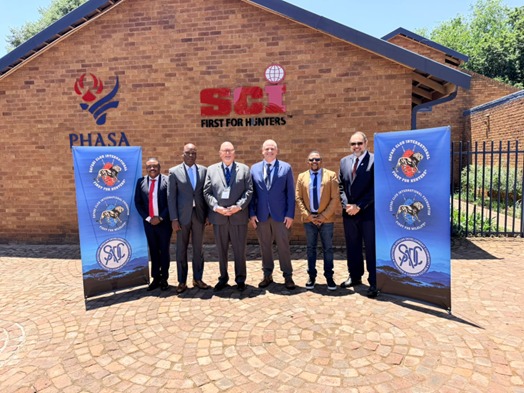
The Southern African Development Community (SADC) Secretariat and its partners, the Safari Club International (SCI) and Safari Club International Foundation (SCIF) have reaffirmed their commitment to strengthen partnership to advance wildlife conservation, sustainable utilisation and law enforcement.
The commitment was made on 13 November 2026 at the SCI Africa Office in Pretoria, Republic of South Africa during the high-level courtesy meeting between SADC and the leadership of the SCI and SCIF which was aimed at reviewing progress and strengthen cooperation in wildlife conservation, sustainable utilisation and law enforcement across the SADC Region.
The SADC delegation was led by Mr. Fahari Marwa, Director of Food, Agriculture and Natural Resources (FANR), accompanied by Dr. George Wambura, Programme Officer – Wildlife. SCI/SCIF was represented by Mr. Laird Hamberlin, Chief Executive Officer CSI and Dr. Christopher Comer, Chief Executive Officer CSIF alongside representatives of the SCI/SCIF Africa Office.
The meeting reviewed progress under the Memorandum of Understanding (MoU) signed in July 2025 and discussed the operationalisation of the two jointly developed Implementation Plans for 2026–2028, focusing on the Convention on International Trade in Endangered Species of Wild Fauna and Flora (CITES) and the SADC Law Enforcement and Anti-Poaching (LEAP) Strategy (2022–2032).
In his remarks, Mr. Marwa expressed appreciation for the technical and financial support provided by SCI/SCIF, particularly in strengthening regional coordination and the effective participation of SADC Member States in CITES processes, including the 20th Conference of the Parties (CoP20). He emphasised that wildlife conservation and sustainable utilisation are integral to regional economic development, tourism, biodiversity conservation and community livelihoods.
The meeting reviewed key achievements, including strengthened regional CITES coordination mechanisms, technical and diplomatic preparations for CoP20, and the development of a structured Roadmap towards CoP21. The CITES Joint Implementation Plan seeks to consolidate these achievements through enhanced scientific and legal preparedness, coordinated proposal development, strategic communications and international engagement.
On their part, the Chief Executive Officers of SCI and SCIF leadership emphasized the importance of science-based wildlife management, responsible and sustainable utilization, and ensuring that the perspectives of African range States are adequately reflected in international conservation policy processes. They pledged continued technical and financial support in line with the joint implementation plans for both the CITES and LEAP Strategy.
Under the proposed LEAP Joint Implementation Plan, the partnership seeks to strengthen practical conservation interventions, building on SCIF’s African Landscape Protection Strategy (ALPS), particularly in the Zambezi Delta in Mozambique and Lower Luano in Zambia. The collaboration will promote landscape protection, community conservation, knowledge exchange, regional coordination and resource mobilization in support of Member States’ priorities.
Following the meeting, the SADC delegation viewed an anti-poaching vehicle procured by SCIF in support of anti-poaching centres in Zambia and Mozambique. Mr. Marwa inspected and test-drove the vehicle, participated in commemorative photographs and expressed appreciation for SCIF’s practical investment in wildlife protection.
The initiative contributes to implementation of the SADC LEAP Strategy, demonstrating how partnerships can complement government-led efforts to combat wildlife crime and protect priority conservation landscapes. The engagement reaffirmed the shared commitment to practical, measurable and sustainable conservation outcomes and improved livelihoods for communities across Southern Africa.


