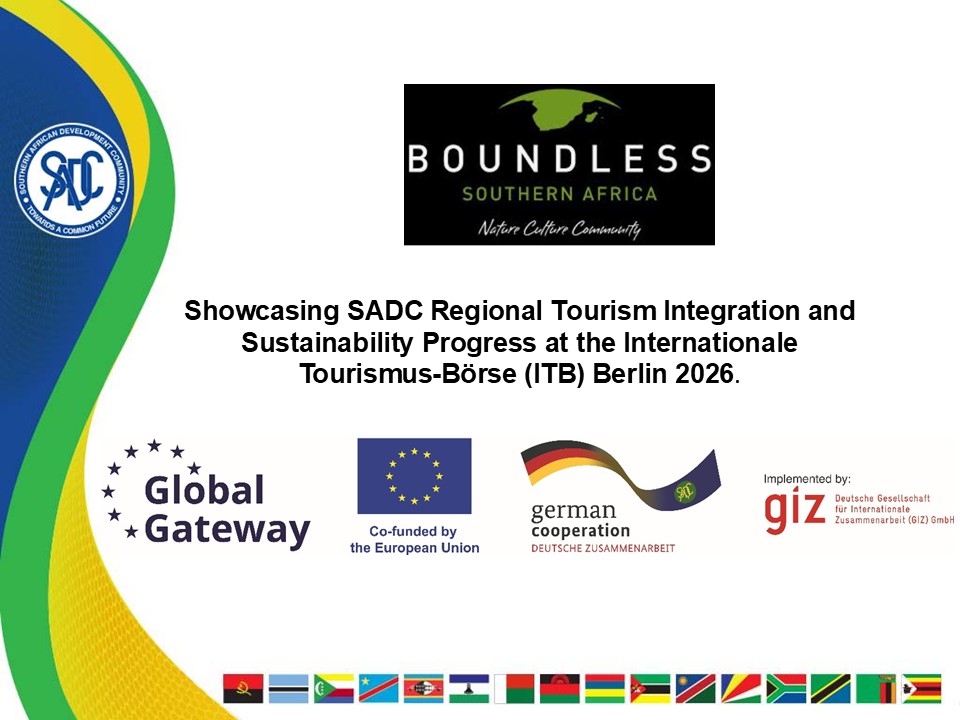
The Southern African Development Community (SADC) Secretariat, together with Boundless Southern Africa (BSA) will present advances in regional tourism integration and sustainability at Internationale Tourismus‑Börse (ITB) Berlin 2026.
A high‑level side event on 4 March 2026, supported by the German Government and the European Union and implemented by Deutsche Gesellschaft für Internationale Zusammenarbeit (GIZ), will update stakeholders on implementation of the SADC Tourism Programme 2020–2030.
The side event will bring together tourism officials, private sector leaders, development partners, investors and the media to review progress on regional tourism and conservation and discuss priorities for boosting competitiveness across Southern Africa.
ITB Berlin is the world’s leading travel trade show, provides an ideal platform for SADC to showcase regional initiatives and engage international stakeholders. The event offers market insights, networking opportunities, and a forum for shaping global tourism trends.
The SADC Tourism Programme 2020–2030 provides a coordinated roadmap sustainable tourism development across the region. Since its adoption, SADC, working with Member States and International Cooperating Partners, has advanced several collaborative initiatives, including significant progress toward a SADC Tourism UniVisa to facilitate cross‑border travel, the development of a regional air access strategy to improve connectivity, and the establishment of a regional tourism disaster risk management and communication framework to strengthen resilience and crisis response.
SADC has also developed a tourism customer service training programme for border officials to enhance visitor experience and streamline cross‑border movement. Progress has been recorded in promoting Transfrontier Conservation Areas (TFCAs) as flagship tourism assets that conserve biodiversity while generating socio‑economic benefits for local communities. Working with tourism private sector organisations, SADC has supported the establishment of the Southern African Tourism Alliance (SATA), a non‑profit, membership‑based association that serves as a catalyst for responsible travel and tourism to, from, and within the SADC region.
Commenting on the Side Event, Marygoreth Mushi, the Programme Officer for Policy and Market Development in the Directorate for Food, Agriculture and Natural Resources (FANR) at the SADC Secretariat noted:
“Regional cooperation remains central to unlocking tourism’s full potential as a driver of inclusive growth, employment, and environmental stewardship across Southern Africa.”
Looking ahead, as the Programme moves into its next implementation phase, emphasis will be placed on the development of critical tools to support tourism development and growth in the region. These tools include the SADC Tourism UniVisa, the SADC Tourism Barometer, the SADC Tourism Sustainability Framework, and strategies to promote tourism market development in TFCAs.
For more information Contact:
Ms. Barbara Lopi, Head of Communication and Public Relations, SADC Secretariat Tel: (+267) 395 1863 (Ext 1790) Email: blopi@sadc.int and Ms. Marygoreth Mushi, the Programme Officer for Policy and Market Development and cc to prinfo@sadc.int
About SADC
SADC is an organisation of 16 Member States established in 1980 as the Southern African Development Coordinating Conference (SADCC) and later, in August,1992 transformed into the Southern African Development Community (SADC). The mission of SADC is to promote sustainable and equitable economic growth and socio-economic development through efficient, productive systems, deeper cooperation and integration, good governance and durable peace and security; so that the region emerges as a competitive and effective player in international relations and the world economy. Member States are Angola, Botswana, Comoros, Democratic Republic of Congo, Eswatini, Lesotho, Madagascar, Malawi, Mauritius, Mozambique, Namibia, Seychelles, South Africa, United Republic of Tanzania, Zambia, and Zimbabwe.
About Boundless Southern Africa
Boundless Southern Africa is a regional tourism initiative which aims to increase the tourism potential of southern Africa by positioning TFCAs as preferred tourist and investment destinations in the region, through consolidating multi-national products into a comprehensive and marketable regional tourism product The development and promotion of tourism in TFCAs provides a tangible opportunity for optimising tourism opportunities based on natural and cultural resources of TFCAs in a market-related manner, through packaging and promoting cross-border tourism itineraries, attractions, experiences and events.
About EU
The European Union (EU) is a unique economic and political union between 27 European countries. The objectives of the EU are to safeguard peace and to ensure economic and social progress through the creation of a European internal market and the strengthening of social cohesion. Over the years, the EU saw its competences expanded through successive treaties. While its vocation was initially primarily economic with the creation of a huge single market, the European Union has become an eminently political entity. From six founding countries or Member States in the 1950s, it has grown into a Union of 27 countries with a population of almost 450 million people, expanding over nearly the whole European continent. Historically, EU’s cooperation support focused on promoting regional economic integration and infrastructure in the Southern African region, and, since the early 2000s, the EU has provided over 400 million Euros to advance the regional integration agenda through SADC. In 2007, cooperation expanded to cover peace and security. In 2014, environmental management and SADC institutional strengthening were added. Currently, the EU’s priority areas are regional economic integration, peace and security, regional natural resources management, and institutional capacity building. These priority areas are aligned with SADC’s Regional Indicative Strategic Development Plan 2020-2030 and Vision 2050.
About Germany
The Federal Republic Germany is the world’s third-largest economy and a founding member of the European Union. German development cooperation exists since 1961. The most important tasks of German development policy include the global realisation of human rights, the fight against hunger and poverty, the protection of the climate and biodiversity, health and education, gender equality, fair supply chains, the use of digitalisation and technology transfer, and the strengthening of private investment to promote sustainable development worldwide. Germany aims to strengthen SADC in order to promote political and economic cooperation in the region. German-SADC cooperation is closely aligned with SADC’s policy priorities as well as to the advancing of the 2030 Agenda for Sustainable Development and the Paris Agreement.
Germany has provided over 500 million Euros to the SADC Secretariat since 1992. Additionally, Germany is undertaking substantial bilateral development cooperation with eight SADC Member States – Democratic Republic of Congo, Madagascar, Malawi, Mozambique, Namibia, South Africa, the United Republic of Tanzania and Zambia. On top of that, Germany is among the top contributors to multilateral institutions such as the EU, UN agencies, IMF, World Bank, AfDB and other development banks

| Attachment | Size |
|---|---|
| ITB 2026 - Side Event Press Release.pdf (198.99 KB) | 198.99 KB |
| LASADC~1.PDF (231.92 KB) | 231.92 KB |
| SADC apresenta os progressos alcançados em matéria de integração e sustentabilidade do turismo regional na ITB Berlin 2026.pdf (197.49 KB) | 197.49 KB |


