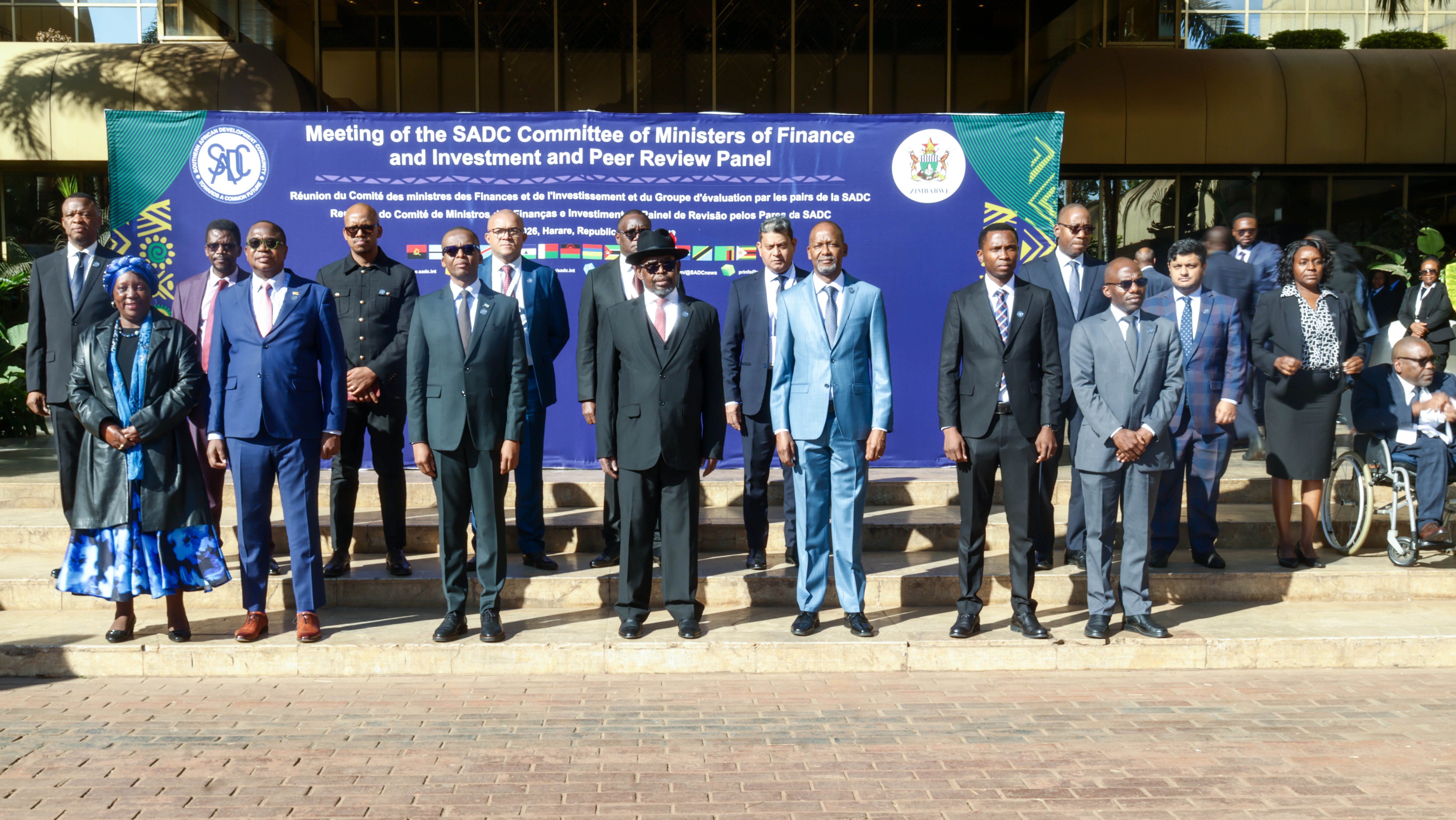
The Southern African Development Community (SADC) Committee of Ministers of Finance and Investment and Peer Review Panel have reaffirmed their commitment to strengthen cooperation in investment, financial integration and macroeconomic surveillance to accelerate inclusive economic growth and regional development.
The commitment was made at the meeting of Ministers of Finance and Investment and Peer Review Panel in Harare, Republic of Zimbabwe on 2 July 2026.
The Chairperson of the SADC Committee of Ministers of Finance and Investment, Honourable Mr Enoch Godongwana, Minister of Finance of the Republic of South Africa highlighted, in his opening remarks, that the new phase of declining aid in southern Africa calls for a structural transformation in development finance across the SADC region
“Beyond protecting critical social sectors, there is an urgent need to pivot toward more sustainable and diversified financing models, leveraging blended finance, public–private partnerships (PPPs), and deeper private sector participation to offset declining donor flows,” the Minister stated.
The Minister called on SADC Member States to adopt coordinated, and forward-looking economic and policy responses to cushion their economies against exogenous negative shocks, including positioning SADC as a competitive regional production hub.
“The Committee of SADC Ministers of Finance and Investment is looked upon to provide solutions to enhance financial resilience whilst embracing innovation, improving climate resilience, and reinforcing strategic partnerships, especially with the private sector,” Hon. Godongwana added.
On his part, the Executive Secretary of SADC, His Excellency Mr. Elias Magosi called for a deliberate shift towards a whole-of-government approach to ensure policy coherence across sectors and levels of governance.
He said this approach, which entails working with all different agencies of government to execute interventions, must be complemented by a re-engineered industrial strategy that promotes value addition, diversification, and regional value chains, alongside a coordinated energy transition framework to guarantee reliable and affordable power for industrialisation.
“Equally, a harmonised approach to critical mineral exploration and development, as well as a modernised agricultural agenda focused on productivity and agro processing, is essential,” Mr. Magosi explained.
He added that interventions should collectively aim to increase intra-SADC trade, strengthen border interconnectivity, and optimise comparative advantage among Member States to deepen regional integration and economic resilience.
The Minister of Finance, Economic Development and Investment Promotion of the Republic of Zimbabwe, Honourable Professor Mthuli Ncube underscored the interconnected nature of SADC economies, stressing that, ‘no SADC Member State can achieve its full potential in isolation.’
“Our economies are connected by geography, history, infrastructure, trade corridors, financial flows and a shared development aspiration,” he highlighted, adding that, “when one Member State becomes more stable, more productive and more connected, the SADC Region, as a whole, becomes stronger.”
The Ministers and the Peer Review Panel agreed on several priority actions to advance the SADC Regional Indicative Strategic Development Plan 2020–2030 and Vision 2050. In this regard,
Ministers noted that the global economic environment continues to be characterised by heightened geopolitical tensions, geoeconomic fragmentation, trade, and tariff disputes, tightening global financial conditions, climate-related shocks, energy insecurity and increasing uncertainty affecting economic growth and macroeconomic stability.
Ministers reaffirmed the importance of strengthening domestic resource mobilisation, promoting industrialisation and value addition, enhancing regional value chains, improving energy and food security and mineral resources management, accelerating implementation of the SADC industrialisation Strategy, and deepening regional trade under both the SADC Free Trade Area and the African Continental Free Trade Area.
Ministers urged Member States to support and accelerate the development of inclusive digital financial ecosystems in the SADC region, by strengthening enabling policy and regulatory frameworks, investing in digital public infrastructure and promoting targeted measures to address key access barriers, particularly for vulnerable groups (women, youth and rural populations) to sustain financial inclusion gains.
Ministers endorsed measures to deepen and integrate SADC capital markets by improving liquidity and depth, expanding product diversity (including sustainable and Islamic finance), and strengthening regulatory, legal, and institutional frameworks across Member States to enhance market efficiency and resilience.
Ministers urged Member States to support targeted policy measures that enhance investment certainty, strengthen value chains, and promote bankable projects to sustain inclusive and resilient investment flows.
Ministers directed the Committee of Insurance, Securities and Non-Banking Financial Authorities (CISNA) to develop a Joint Strategy and Roadmap for the transition of medical aid schemes to non-bank financial services regulators, supported by technical working groups
Ministers prioritised structural reforms that strengthen productivity, competitiveness, and economic diversification, while prioritising infrastructure development, formal sector growth, regional trade and value chains, and climate resilience to advance economic sovereignty and achieve sustainable, inclusive, long-term economic growth.
Ministers underscored the importance of the SADC Regional Development Fund (RDF) and directed the Secretariat to work with the African Development Bank and the SADC Development Finance Institutions Network to explore further measures and mechanisms concerning the establishment of the Fund through a standalone Special Purpose Vehicle (SPV) with a Permanent Capital Structure; and to operationalise the Fund in a staged approach, beginning with the Proof‑of‑Concept Stage, as approved by the Council of Ministers at its meeting in March 2025
Ministers urged Member States to fast-track the signing, ratification and accession of SADC Protocols and legal instruments including the Agreement of the Operationalisation of the Regional Development Fund, SADC Agreement on Assistance in Tax Matters and the SADC Protocol on Finance and Investment and its annexes.
Ministers endorsed measures to deepen and integrate SADC capital markets by improving liquidity, expanding product diversity including sustainable and Islamic finance, and strengthening regulatory frameworks.
Ministers urged Member States to expedite onboarding of national currencies to the SADC Regional Real Time Gross Settlement System to enable faster cross-border payments and approved the prototype concept for interconnectivity of SADC stock exchanges and operationalisation of a cross-border securities settlement framework under SADC-RTGS.
Ministers agreed to strengthen Anti-money Laundering and Combating the Financing of Terrorism (AML/CFT) frameworks aimed at mitigating financial crimes, including money laundering and terrorist financing.
Ministers reflected on outcomes of the SADC Foreign Affairs Ministers Retreat held in May 2026 in Skukuza, Mpumalanga, Republic of South Africa which was convened to assess global geopolitical impacts on the region and urged Member Staters to, among others, identify and advance flagship regional projects including the Lobito refinery, Mozambique gas project, and regional textile value chains for collective financing.
The meetings of the Committee of Ministers of Finance and Investment and Peer Review Panel were in line with the provisions of the SADC Protocol on Finance and Investment which provides the legal framework for regional cooperation and harmonisation in finance, investment, and macroeconomic policy. The Protocol emphasises aligning Member States’ financial and investment policies with SADC’s overarching objectives to prevent policy shifts in one country from adversely affecting others.
The SADC Committee of SADC Ministers of Finance and Investment facilitates regional integration, cooperation, and coordination in these sectors, aiming to diversify and expand productive activities, enhance trade, and support sustainable economic growth and poverty reduction. It also seeks to foster a favourable investment climate, promote and attract investment, ensure macroeconomic stability and convergence, and strengthen cooperation on taxation and related matters across the region.
The SADC Peer Review Panel consists of Finance Ministers and Central Bank Governors from all Member States and is charged with the responsibility to monitor and review macroeconomic convergence, determine specific targets, assess progress of the set targets and provide advice on corrective action to ensure policy coherence and macroeconomic stability in the SADC region.


