
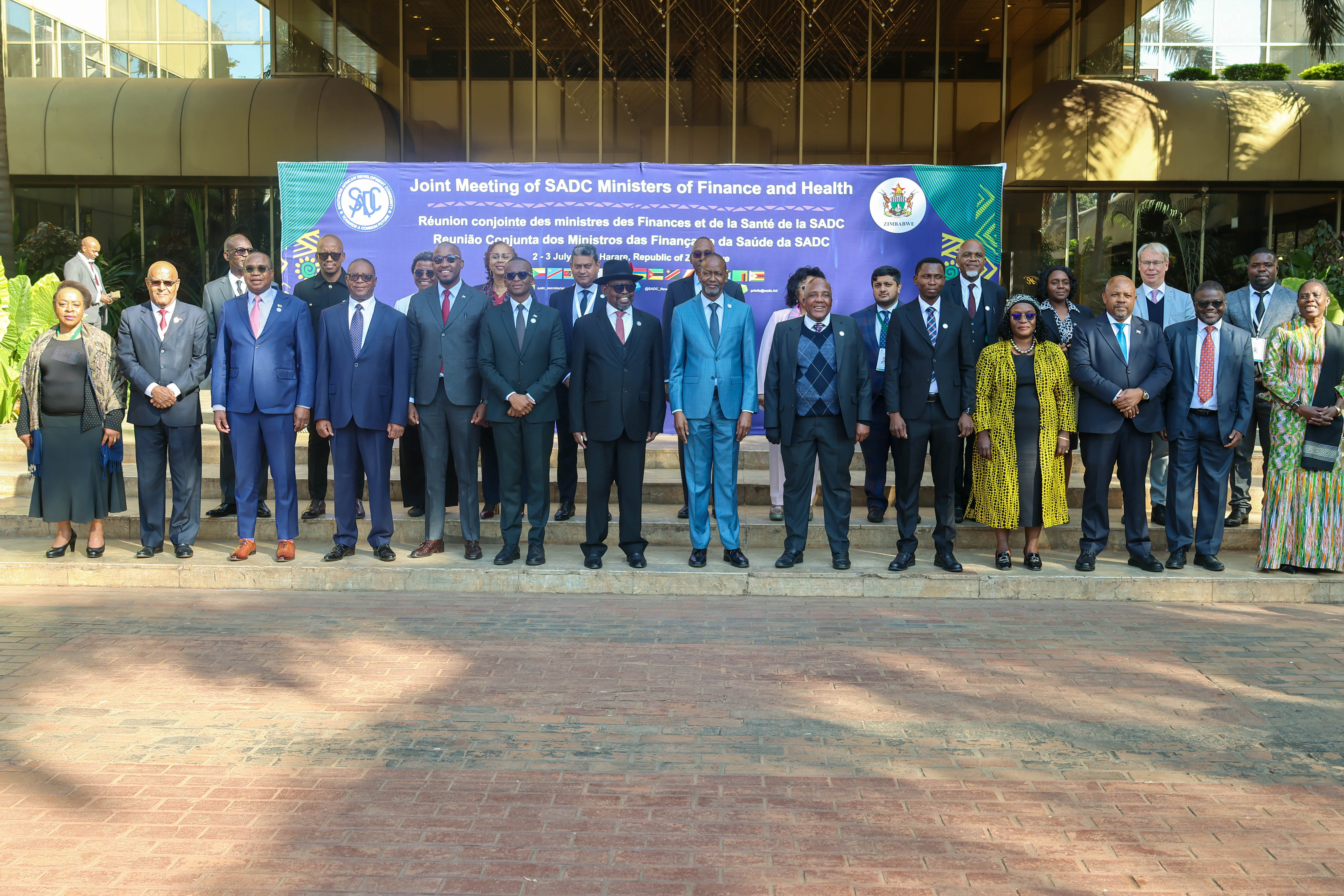
During the Joint Meeting of the Southern African Development Community (SADC) Ministers of Finance and Health held in Harare, Republic of Zimbabwe, on 2–3 July 2026, the Ministers stressed the need to sustainably finance health systems amid declining donor support, rising fiscal pressure, and increasing health threats, such as the Ebola Outbreak.
In his remarks, Honourable Dr. Douglas Mombeshora, the Minister of Health and Child Care of the Republic of Zimbabwe, who was one of the Co-Chairpersons of the meeting alongside Honourable Dr. Aaron Pakishe Motsoaledi, Minister of Health of the Republic of South Africa, linked health financing directly to regional security and called for coordinated response.
Hon. Dr. Mombeshora stressed the cost of inaction, “We have learned this lesson at a terrible price - through COVID-19, and through every Ebola outbreak the continent has confronted. And the lesson is consistent: preparedness is always cheaper than response.”
He called for sustainable, predictable financing for pandemic preparedness as a regional public good.
On his part, Hon. Professor Mthuli Ncube, Minister of Finance, Economic Development and Investment Promotion of the Republic of Zimbabwe, stated that health and economic prosperity go hand in hand.
“We cannot build strong economies without healthy populations, and we cannot sustain quality health systems without sound public finances,” he stated while flagging the new reality of declining aid for the SADC region.
The SADC Executive Secretary His Excellency Mr. Elias Magosi underscored the need to build stronger and more resilient health systems, capable of preventing, detecting and responding to future public health emergencies more effectively.
He therefore urged Ministers to sustain political commitment, pursue coordinated resource mobilisation, build partnerships and cultivate regional solidarity to protect the health and well-being of the SADC citizens
The Ministers acknowledged that failure to strengthen sustainable health financing can reverse the considerable progress made over the years in health outcomes and human capital development, while affecting the most vulnerable, particularly young women and men. Accordingly, they adopted an Outcome Statement on Health Financing outlining the following priority actions by SADC:
Strengthen domestic resource mobilisation for health, by accelerating fiscal reforms, promoting Public-Private Partnerships, and implementing innovative financing mechanisms including Debt-for-Health swaps, in line with the African Union 2025 Theme on Reparative Justice.
Accelerate operationalisation of the SADC Pooled Procurement Services through legal, policy and institutional reforms and harmonisation of regulatory frameworks. This includes strategic purchasing, leveraging regional markets, and Health Technology Assessments to negotiate volume-based discounts, reduce unit costs, and lower catastrophic out-of-pocket expenditures.
Promote local manufacturing of health commodities, by creating an enabling investment environment for vaccines, medicines, diagnostics, and other health technologies.
Strengthen financial protection for citizens by prioritising preventive and primary healthcare and accelerating the establishment of National Health Insurance schemes and other sustainable financing mechanisms to reduce out-of-pocket expenditure.
Strengthen accountability and sustainability through improved public financial management, efficiency-enhancing measures, pooled and e-procurement, and protecting frontline service delivery by progressively absorbing critical donor-funded health workers, including community health workers, onto national payrolls via Medium-Term Expenditure Frameworks.
Enhance preparedness through contingency plans and readiness self-assessments and commended the World Health Organisation (WHO) and Africa Centre for Disease and Control and Prevention (Africa-CDC) for continued support to SADC Member States.
The SADC Deputy Executive Secretary for Regional Integration made a case for the need to operationalise the SADC Pooled Procurement of Services, noting that the SPPS is a game changer in regional procurement and supply chain management of essential medicines and health commodities in the SADC region.
As a sign of continental and global solidarity in addressing the health challenges, the meeting featured presentations from Dr. Mohamed Yakub Janabi, WHO Regional Director for Africa, Ambassador Amma Twum-Amoah, African Union Commissioner for Health, Humanitarian Affairs and Social Development, Dr. Donald Kaberuka, AU Special Envoy for Health Financing and Ms. Nardos Bekele-Thomas, Chief Executive Officer of the African Union Development Agency (AUDA-NEPAD).


