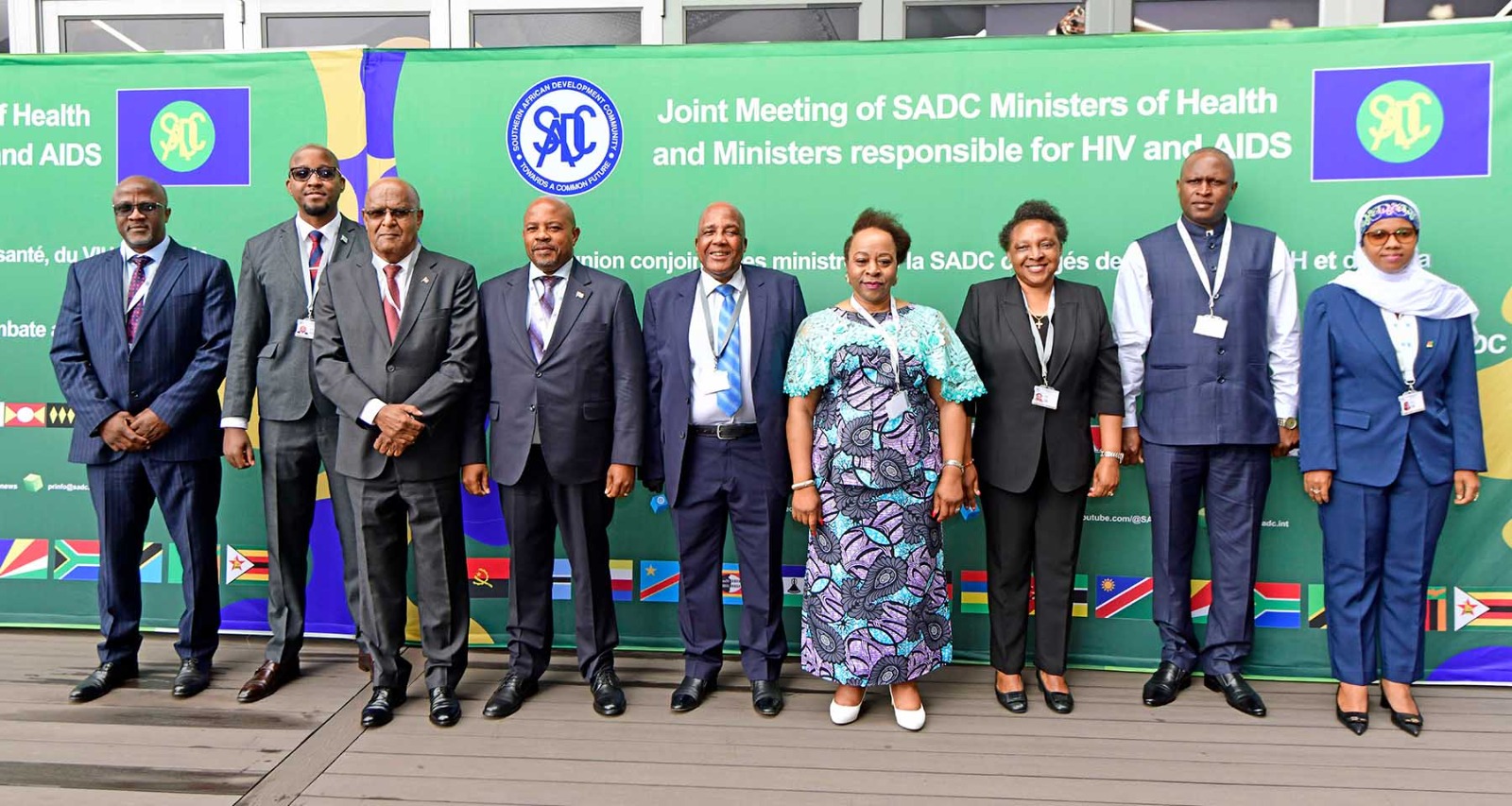
The Southern African Development Community (SADC) Ministers of Health and Ministers responsible for HIV and AIDS convened a meeting to review the general state of health in the region, with a focus on major public health concerns such as health emergencies, disease outbreaks and preparedness, Tuberculosis, Malaria, Nutrition, and HIV & AIDS in Johannesburg, Republic of South Africa, on 24th February 2026.
The Ministerial Meeting was chaired by the Republic of South Africa’s Minister of Health, Dr. Aaron Motsoaledi, and Chairperson of the SADC Ministerial Committee on Health. The meeting was attended by SADC Ministers or their representatives from Angola, Botswana, Democratic Republic of Congo, Eswatini, Madagascar, Malawi, Mozambique, Namibia, South Africa, United Republic of Tanzania, Zambia and Zimbabwe. The meeting was also attended by Ms. Angele Makombo N’tumba, SADC Deputy Executive Secretary for Regional Integration. The meeting was also attended by World Health Organization Africa Regional Office, Joint United Nations Programme on HIV and AIDS (UNAIDS)- East and Southern Africa and United Nations Population Fund (UNFPA), and United Nations Children’s Fund (UNICEF) as well as other Partners including Government of Sweden, AUDA-NEPAD, East and Southern Africa Health Community (ECSA-HC), African Leaders Malaria Alliance (ALMA), African Institute for Development Policy (AFIDEP) among others.
Honourable Dr. Aaron Motsoaledi, Minister of Health for the Republic of South Africa and Chairperson of the SADC Ministerial Committee on Health delivered the official opening remarks. He highlighted that a self-reliant Africa is essential for global health security and should be treated as a strategic priority like investment in infrastructure and security. Honourable Dr. Motsoaledi called upon the International Cooperating Partners to support SADC’s vision for attaining health security.
He urged Ministers to move beyond rhetoric and develop concrete roadmaps that translate the vision of health sovereignty into reality and identify the bottlenecks in local manufacturing, gaps in financing and barriers in the regulatory system. “Let us leave this meeting with a clear measurable commitment to hold each other accountable”, he said.
Ms. Angele Makombo N’tumba, SADC Deputy Executive Secretary for Regional Integration in her opening remarks, highlighted that for the past decade, several Member States have recorded measurable improvements in several areas such as child survival and reductions in stunting because of sustained policy commitments and collaboration across sectors. She however, noted that the region's burden of malnutrition remains a major threat as more than 23 million children are stunted in the SADC region and equally alarming is the 34% of women of childbearing age who are affected by anaemia.
The Deputy Executive Secretary emphasised that health costs of managing non- communicable diseases have become a great burden to Member States, requiring innovative interventions and financing solutions. “Addressing the burden of malnutrition requires both stronger multi-sectoral alignment across health, WASH, agriculture, and social protection, including urgent investments in integrated nutrition and comprehensive adolescent health services to close this critical gap” she said.
Dr. Mahammed Yakub Janabi, World Health Organisation Africa Regional Director called on countries to adopt innovative financing mechanisms to address the severe health‑funding pressures experienced in 2025. He cautioned that traditional budget allocations alone will not be enough to sustain resilient health systems.
Dr. Janabi said many African countries are beginning to shift their priorities, recognising that health can no longer be treated as a cost but must be positioned as a high‑budget investment that supports economic and social development. “I have seen Ministers of Health changing priorities. Health is not a cost anymore, and it must be high in the budgets of countries,” Janabi said.
Ms. Lydia Zigomo, UNFPA Regional Director for East and Southern Africa said the SADC region continues to lead globally in HIV the response, with sustained reductions in new infections and AIDS-related deaths driven by a combination of prevention and treatment scale-up. “We are at a decisive moment where gains will either be accelerated, sustained or reversed,” Zigomo said. However, she warned that the region cannot afford to be complacent, especially given that adolescent girls and young women suffer the most in terms of new HIV infections.
On her part, Ms. Anne Githuku - Shongwe, UNAIDS Regional Director for East and Southern Africa reiterated UNAIDS’ commitment in collaborating with SADC on improving HIV prevention and increasing domestic financing for HIV programs to safeguard long-term sustainability. She underscored the importance of ensuring long term sustainability of essential community health systems which play a critical role in the HIV and AIDS response.
The Ministers noted the severe flooding caused by heavy rainfall in the region and that the rains had resulted in surges in Malaria and water borne diseases such as Cholera. It was noted that progress towards malaria elimination had regressed significantly in the region and that efforts to eliminate malaria should be accelerated to meet the 2030 elimination targets. Similarly, strengthening rapid malaria surveillance and reporting while prioritising flood affected areas, cross border surveillance, early detection of malaria outbreaks, deployment of emergency malaria commodities such as insecticide treated nets, RDTs, antimalarials to displaced populations and hard-to-reach areas and intensify vector control activities, including targeted indoor residual spraying (IRS) are critical for cross border malaria control.
Ministers endorsed the SADC Regional Strategy for Strengthening Emergency and Essential Surgery, Anaesthesia, Nursing, Obstetrics and Gynaecology (2025–2030), reaffirming their collective commitment to integrate safe, timely and affordable surgical and perioperative care into Universal Health Coverage across the region. The Strategy provides a coordinated framework for regional and country work to address the growing burden of trauma, maternal and women’s health conditions, cancers and other non-communicable diseases, while strengthening district-level service delivery, workforce capacity, quality and patient safety systems among other action. Ministers emphasized that advancing emergency and essential surgical care is critical to reducing preventable deaths, improving maternal and women’s health outcomes, and accelerating progress toward the Sustainable Development Goals in the SADC region.
The Ministers noted that there had been recent outbreaks of polio and measles in some Member States and that there have been some containment measures including advocacy and a call was made for Member States to strengthen surveillance, data sharing and response, and continue implementing National and Regional Cholera costed plans and undertake advocacy towards increasing vaccine availability and financing.
The Ministers noted the status of Tuberculosis in the Region. The report spotlights a high incidence of TB among males and urged Member States to implement recommendations of the SADC TB report including male focused interventions such as screening for TB in mines, male prisons, and other male dominated settings. The Ministers endorsed the 2024 SADC TB Report further directing the Secretariat to work with WHO and other partners to support AI driven TB diagnostics that will support strengthening of primary health care interventions towards improving early TB diagnosis and management.
Ministers noted progress made in the implementation of SADC’s SRHR Strategy and Scorecard as well as findings from the Mid-Term Review. Within the 4 pillars of the Strategy there has been progress and notably the SADC Secretariat has mobilised resources from Sweden AUDA-NEPAD, UN Together4SRH and Team Europe Initiative to advance the region’s SRHR agenda.
On strengthening the Integration of Climate Change and Sexual and Reproductive Health, the Ministers noted the report from the SADC Regional Climate Change and Sexual and Reproductive Health Indaba, endorsed the SADC Regional Outcomes and Key Recommendations Statement on Climate Change and Sexual and Reproductive Health and urged Member States to adopt and implement the recommendations of the SADC Regional Outcomes and Key Recommendations Statement on Climate Change and Sexual and Reproductive Health. The Ministers also directed the Secretariat to develop a SADC Regional Sexual and Reproductive Health/Climate Action Framework and work with its partners to mobilise resources to support Member States to advance sexual and reproductive health integration in the context of climate related disasters.
The Ministers noted the progress made by the Republic of South Africa towards securing a voluntary license to locally manufacture Lenacapavir, to ensure that it is affordable and accessible in the region. Ministers expressed their support towards South Africa’s efforts and directed the SADC Secretariat to establish a regional task force to support South Africa’s application in obtaining the license to manufacture Lenacapavir.
The Ministers endorsed the report of the 2025 SADC HIV Score Card which aims to prevent the transmission of the HIV and AIDS. The Score Card is anchored on the five pillars of prevention which are Adolescent Girls and Young women (AGYW), Key Populations (KP), Condoms, Voluntary Medical Male circumcision (VMMC), and Pre-Exposure Prophylaxis (PrEP). The Ministers also urged Member States to implement the recommendations from the report and to prioritise the interventions targeting the most vulnerable and Key populations and ensure that no one is left behind.


