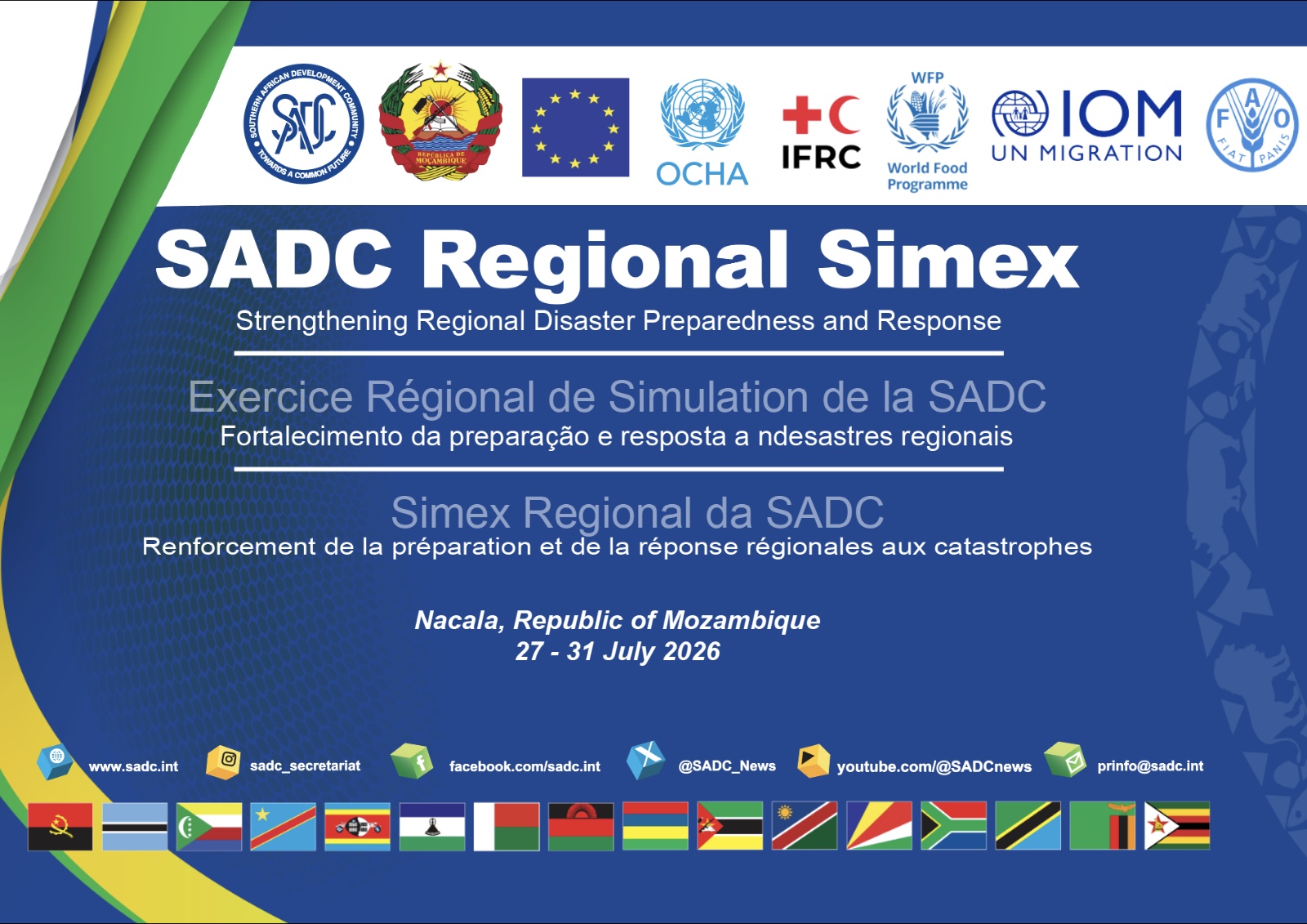
The Southern African Development Community (SADC), in collaboration with the Government of the Republic of Mozambique, Member States and regional and international partners, is set to conduct a Regional Cyclone and Flood Response Simulation Exercise (SIMEX) from 27-31 July 2026 in Nacala, Mozambique.
The SIMEX will provide a practical platform to test regional operational readiness for disaster preparedness and response; strengthen the execution of the mandate of the SADC Humanitarian and Emergency Operations Centre (SHOC); and enhance effective regional coordination, interoperability and strategic partnerships for disaster preparedness and humanitarian response.
This exercise represents an important opportunity to translate regional commitments into practical action. By bringing together SADC, Member States and partners in a realistic operational setting, the SIMEX will reinforce shared understanding of roles and responsibilities, build confidence in regional response arrangements, and demonstrate how preparedness, early warning and timely coordination can help save lives and protect development gains.
The SIMEX comes at a critical time as the SADC Region continues to face increasingly frequent, complex and interconnected disasters. Tropical cyclones, floods, droughts and other climate-related hazards can rapidly overwhelm national capacities and generate impacts that transcend national borders, underscoring the importance of strong regional mechanisms and collective action.
Through a simulated severe tropical cyclone and flooding scenario, SADC Secretariat, Member States and partners will test the regional disaster preparedness and response mechanisms, from risk monitoring, early warning and anticipatory action to regional activation, deployment, humanitarian coordination and response. The exercise will practice the mobilization and deployment of the SADC Emergency Response Team (ERT), while also exploring the operational readiness of the SADC Standby Force to support humanitarian operations, including search and rescue and logistics.
At the centre of the exercise will be the SHOC, based in Nacala, which will practice its mandate as the regional operational hub for humanitarian and emergency coordination. This will include regional hazard monitoring and early warning, situational awareness, information management, coordination of regional response mechanisms and support to affected Member States
At the centre of the exercise will be the SHOC, based in Nacala, which will practice its mandate as the regional operational hub for humanitarian and emergency coordination. This will include regional hazard monitoring and early warning, situational awareness, information management, coordination of regional response mechanisms and support to affected Member States.
The SIMEX will also strengthen coordination and interoperability among SADC, Member States and strategic partners, including United Nations Office for the Coordination of Humanitarian Affairs (UN OCHA), International Federation of Red Cross and Red Crescent Societies (IFRC), the European Union (EU), European Civil Protection and Humanitarian Aid Operations (ECHO), World Food Programme (WFP), United Nations Food and Agriculture Organization (FAO), United Nations Disaster Assessment and Coordination (UNDAC), International Organization for Migration (IOM), the Regional Anticipatory Action Working Group (RAAWG), the Stock of Humanitarian Organisations Logistics Mapping (STOCKHOLM Platform) and United Nations Platform for Space-based Information for Disaster Management and Emergency Response (UN-SPIDER), among others. These partnerships bring complementary capacities in humanitarian coordination, anticipatory action, emergency logistics, information management and technical support that are critical to an effective regional response.
At the conclusion of the exercise, an After-Action Review will identify operational and coordination gaps, capture lessons and develop priority recommendations to further strengthen regional preparedness and response mechanisms.
Through the SIMEX, SADC and its partners reaffirm their commitment to building a coordinated, interoperable and anticipatory regional disaster preparedness and response system founded on strategic partnerships and regional solidarity, ensuring that when disaster strikes, the Region is ready to act together to protect lives, livelihoods and development gains.


