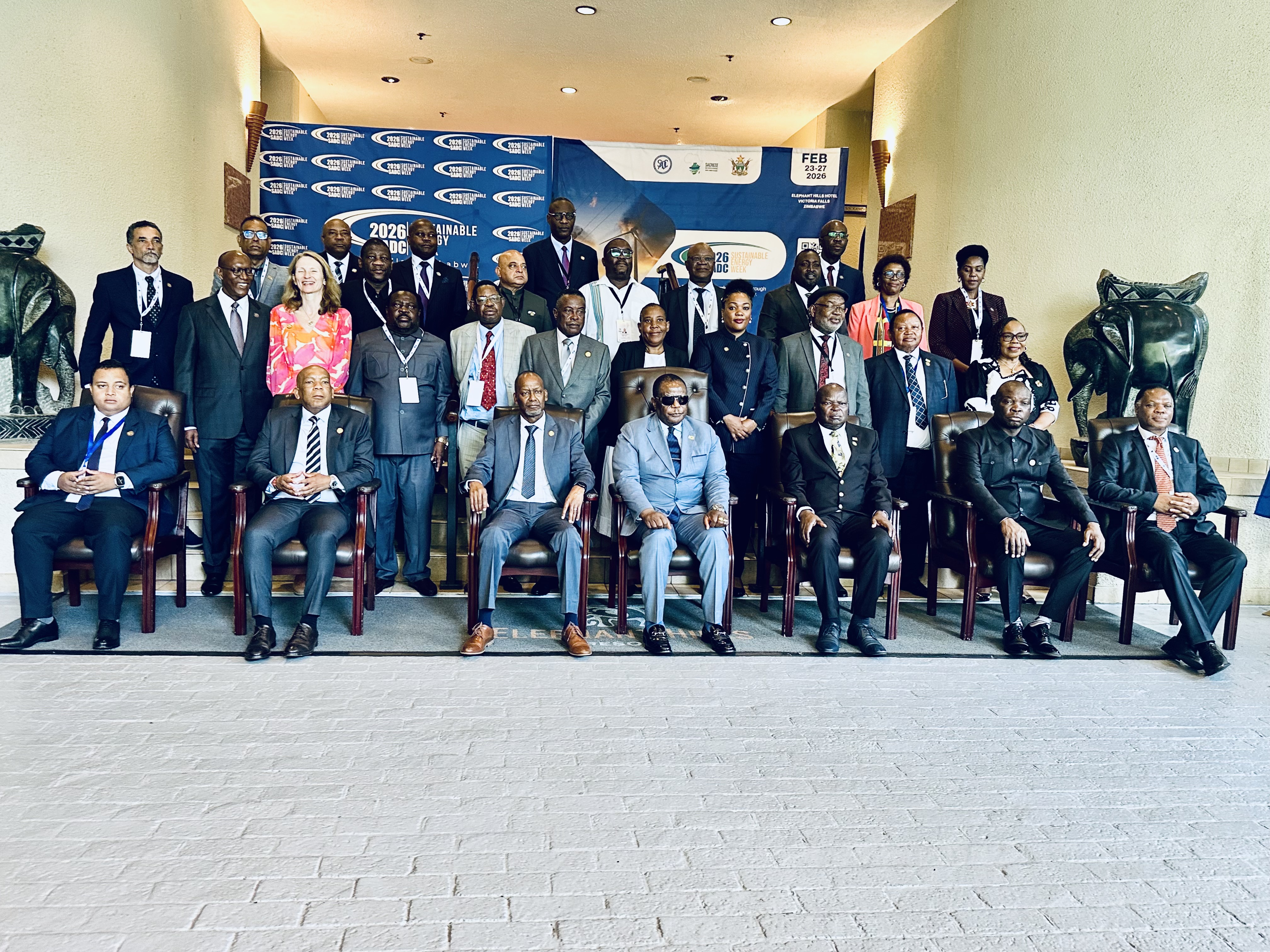
The 2026 Southern African Development Community (SADC) Sustainable Energy Week (SEW) concluded in Victoria Falls, Zimbabwe, with strong commitments from Member States and partners to accelerate clean energy deployment, strengthen regional integration, and expand energy access across Southern Africa.
Hosted by the Government of the Republic of Zimbabwe through the Ministry of Energy and Power Development from 23-27 February 2026, the Conference was held under the theme: “Driving Regional Economic Growth Through Clean Energy and Energy Efficiency.”
The event was officially opened by the Vice President of the Republic of Zimbabwe, General (Rtd) Honourable Dr. Constantino Guvheya Dominic Nyikadzino Chiwenga, representing His Excellency Dr. Emmerson Dambudzo Mnangagwa, President of the Republic of Zimbabwe.
The Conference was attended by Ministers responsible for Energy and Heads of Delegation from across the SADC region, including:
Hon. July G. Moyo – Minister of Energy and Power Development, Zimbabwe (Host Minister)
Hon. Bogolo Joy Kenewendo – Minister of Minerals and Energy, Botswana
HRH Prince Lonkhokhela – Minister of Natural Resources and Energy, Eswatini
Hon. Ny Ando Jirice RALITERA – Minister of Energy and Hydrocarbons, Madagascar
Hon. Dr. Kgosientso Ramokgopa – Minister of Electricity and Energy, South Africa
Hon. Makozo Chikote – Minister of Energy, Zambia
Hon. Salome Wycliffe Makamba – Deputy Minister for Energy, United Republic of Tanzania
Ministers and Deputy Ministers for other portfolios such as mining, industrialisation and environment from the Republic of Zimbabwe were in attendance;
Senior representatives from the Democratic Republic of Congo, Lesotho, Malawi, Mauritius, Mozambique, Namibia and Seychelles.
In his remarks, the SADC Executive Secretary, H.E. Mr. Elias M. Magosi, underscored that energy remains central to industrialisation, economic growth, and improved livelihoods across the Region. He noted progress made since the inaugural SEW in February 2025, including the advancement of National Energy Compacts and strengthened regional cooperation under the Mission 300 initiative.
Conference deliberations highlighted persistent challenges in energy availability, affordability and access, particularly in rural areas, as well as inadequate transmission infrastructure and limited policy harmonisation affecting cross-border power trade.
Participants adopted a set of priority actions aimed at accelerating implementation, including:
Expediting key regional interconnector projects such as Angola-Namibia, Malawi-Mozambique and Tanzania-Zambia to enhance power trading through the Southern African Power Pool (SAPP);
Accelerating universal access to electricity by 2030 through mini-grids, solar rooftop systems and off-grid solutions;
Harmonising regulatory frameworks to strengthen private sector participation, including independent power producers (IPPs) and independent transmission system operators (TSOs);
Scaling up energy efficiency as a “first fuel” through standards, labelling and financing mechanisms;
Promoting diversification of the regional energy mix, including utility-scale solar, green hydrogen and other clean energy technologies;
Supporting women and youth participation in renewable energy value chains; and
Advancing electrification of transport and clean cooking initiatives across the Region.
The Conference further urged Member States to expedite implementation of approved National Energy Compacts and commended development partners, including the World Bank Group and the African Development Bank, for their continued technical and financial support.
The Republic of Zimbabwe was commended for successfully hosting the 2026 SADC Sustainable Energy Week, and the Kingdom of Eswatini was acknowledged for accepting to host the 2027 edition.
The 2026 SADC Sustainable Energy Week reaffirmed the Region’s collective resolve to strengthen energy security, advance energy equity, and ensure environmental sustainability while driving inclusive and sustainable economic transformation in Southern Africa.


