
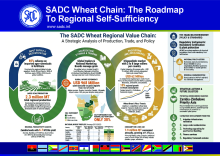
The SADC wheat regional value chain analysis highlights five key segments shaping the sector’s performance: input supply and mechanisation, large-scale production, aggregation and storage, processing, and consumption and end-use, supported by an enabling policy and regulatory environment. The value chain remains highly dependent on imported fertilisers and agrochemicals, while production is largely driven by commercial farmers in South Africa and Zambia, where mechanisation and investment have contributed to higher yields. Despite strong productivity in leading countries, regional self-sufficiency remains limited at around 30%, resulting in significant wheat import requirements valued at approximately USD 968 million annually. Aggregation and storage are managed by global traders and national marketing institutions, while processing is concentrated among large-scale millers with opportunities for expanded regional value addition. Growing wheat consumption, increasing demand for flour-based products and opportunities for cross-border production clusters, particularly along the Zambia–Zimbabwe corridor, provide a foundation for strengthening the sector. Priority interventions include improving irrigation infrastructure, expanding mechanisation, upgrading post-harvest technologies, increasing access to finance and enhancing regulatory harmonisation to build a more resilient and self-sufficient SADC wheat value chain.


