
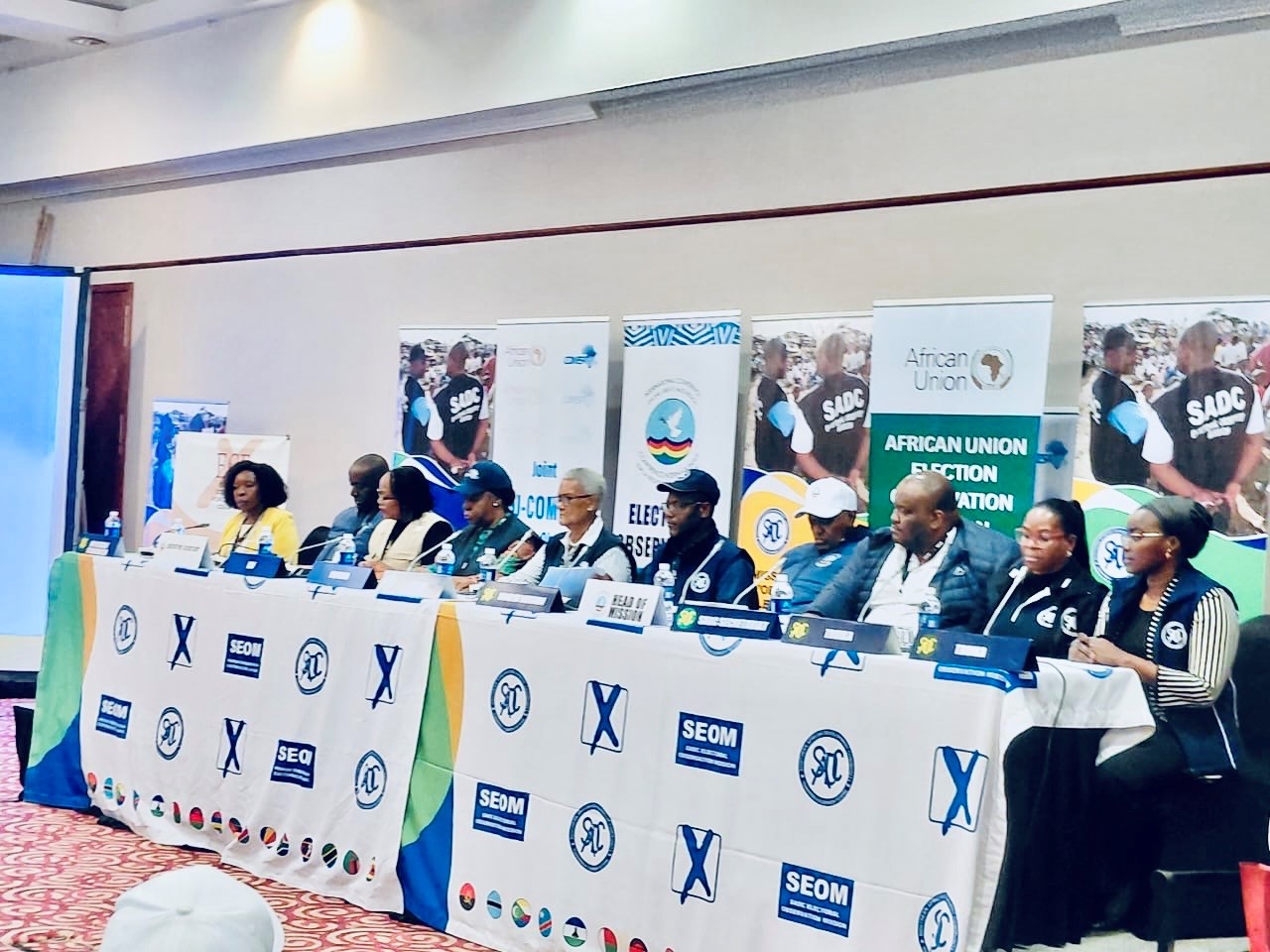
Heads of international and regional Election Observation Missions deployed to observe the Republic of Zambia’s General Election held on 13 August 2026 have released their preliminary statements, presenting their initial findings on the electoral process and calling on all stakeholders to remain calm and allow the Electoral Commission of Zambia (ECZ) to complete the ongoing results process.
The preliminary statements were presented in Lusaka by Honourable Samuel B. Tembenu, SC, Former Minister of Justice and Constitutional Affairs of the Republic of Malawi and Head of the Southern African Development Community Electoral Observation Mission (SEOM); Ambassador Marie-Pierre Lloyd, Member of the COMESA Panel of the Wise and Deputy Head of the Joint African Union–COMESA Electoral Observation Mission; His Excellency Dr. Mokgweetsi Eric K. Masisi, Former President of the Republic of Botswana and Head of the International Conference on the Great Lakes Region (ICGLR) Election Observation Mission; and Honourable Justice Annabel Mtalimanja, Chairperson of the Malawi Electoral Commission and Head of the Electoral Commissions Forum (ECF) Election Observation Mission.
The release provided an opportunity for the Missions to share their respective observations on the pre-election environment, Election Day processes, voting, closing and counting, as well as developments in the immediate post-election period.
SADC Electoral Observation Mission
Presenting the SEOM Preliminary Statement, Hon. Tembenu said the Mission had deployed 106 personnel from ten SADC Member States, organised into 17 Short-Term Observer Teams covering all ten provinces of Zambia. On Election Day, SEOM observed 277 polling stations out of the 13,529 polling stations established for the elections.
SEOM observed that the political environment in most areas of deployment was peaceful and that most stakeholders consulted considered the environment an improvement compared with the 2021 elections. The Mission also noted several positive practices, including the preparedness of the ECZ, transparent verification and custody of electoral materials, and the functioning of conflict-management committees.
On Election Day, the Mission found the atmosphere calm and peaceful at 275 of the 277 polling stations observed. It nevertheless identified areas requiring further attention, including the absence of dedicated legislation governing the management, funding and accountability of political parties; the timing and communication of electoral reforms; aspects of the new Mixed Member Proportional Representation system; media freedom; inclusion of women and persons with disabilities; electoral violence and the secrecy of the ballot.
SEOM consequently recommended, among other measures, prioritising legislation on political parties, undertaking electoral reforms sufficiently ahead of elections, strengthening participation by women, youth and persons with disabilities, ensuring equitable media coverage, investigating electoral violence and intimidation, and safeguarding ballot secrecy.
The Mission expressed particular concern over the uncertainty and anxiety that followed the temporary suspension of counting and announcement of results on 14 August 2026. Following the resumption of the process later that evening, SEOM urged contestants, supporters and all stakeholders to remain calm, refrain from violence or interference with electoral officials and materials, and pursue grievances through established legal remedies.
Joint African Union–COMESA Electoral Observation Mission
The Joint AU–COMESA Electoral Observation Mission deployed 93 Short-Term Observers drawn from 27 African countries, with women comprising 52 per cent of the Mission. Thirty-three observer teams were deployed across eight provinces, observing voting procedures in 740 polling stations across the country.
The Mission observed that voting was conducted in a generally peaceful and orderly environment in the overwhelming majority of polling stations visited. It commended the participation of Zambian citizens, the Government’s full funding of the elections, the introduction of the Mixed Member Proportional Representation system to enhance inclusion, efforts to identify persons with disabilities on the voters’ register, and measures aimed at strengthening transparency and electoral dispute resolution.
At the same time, AU–COMESA raised concerns over late electoral reforms, the absence of legislation regulating political parties, incidents of political violence, aspects of media freedom, the representation of women, congestion and delays at some polling stations, and the management of the results process.
The Mission stressed that the integrity of results management depends on adherence to the law, transparent communication by the ECZ and restraint by political actors from making premature declarations, underscoring that official election results should be announced by the ECZ.
AU–COMESA commended the people of Zambia for exercising their democratic right and urged all stakeholders to remain calm, exercise restraint, allow the ECZ to complete counting and verification, and use established legal and institutional mechanisms to resolve any electoral disputes peacefully.
ICGLR Election Observation Mission
H.E. Dr. Mokgweetsi Eric K. Masisi reported that the ICGLR Election Observation Mission comprised close to 100 observers deployed across Zambia to observe the opening, voting, closing, verification and counting processes.
The ICGLR Mission assessed the processes it observed as, on the whole, transparent, fair, legal and peaceful. It noted provisions to facilitate voting by elderly persons, expectant mothers and persons with disabilities, as well as the generally professional conduct of security personnel. The Mission nevertheless raised concern over the recording of unique voter numbers on ballot papers, noting the implications this could have for the secrecy of the ballot.
H.E. Dr. Masisi also addressed developments surrounding the temporary suspension of vote counting and announcement of results. As tensions rose, Heads of the international observation missions jointly engaged key political actors through preventive diplomacy, calling on both the ruling party and the main opposition to de-escalate tensions, refrain from premature announcements and inflammatory language, respect the rule of law and allow the lawful electoral process to continue.
Following engagements with the ECZ, the Heads of Mission were briefed on the reasons for the suspension and the measures being undertaken to secure ballots and resume the process. The ICGLR Mission renewed its call for calm, restraint, respect for the rule of law and patience until the official results are announced by the ECZ.
Electoral Commissions Forum Election Observation Mission
Hon. Justice Annabel Mtalimanja presented the initial statement of the ECF Mission, which comprised 40 observers drawn from 11 member Electoral Commissions and deployed teams to Lusaka, Southern, Central, Eastern and Copperbelt provinces.
The Mission reported that Election Day procedures generally proceeded well, with no reports of widespread intimidation or significant disruption to polling. It nevertheless identified operational and logistical challenges, including delays in the delivery of electoral materials and inadequacy of some materials.
Recognising the importance of the ongoing results process, the ECF Mission extended the stay of its leadership in Zambia until 19 August 2026. During this period, it will continue observing the results tallying process, provide peer support to the ECZ and work with other international observation missions involved in preventive diplomacy.
The Mission called on all electoral stakeholders to exercise restraint and channel grievances through legally established mechanisms. It also encouraged the ECZ to provide regular and detailed information to the public as the announcement of results continues.
Regional Missions Call for Calm and Respect for the Electoral Process
Across the four statements, the observation missions emphasised the importance of maintaining peace, respecting the rule of law and safeguarding the integrity of the remaining stages of the electoral process.
The Missions further demonstrated continued regional and continental cooperation through consultations and preventive diplomacy aimed at contributing to de-escalation, confidence-building and the peaceful conclusion of Zambia’s electoral process.
While the preliminary assessments highlighted positive aspects of Election Day and the commitment of Zambian citizens to exercising their democratic rights, the Missions also identified areas requiring improvement and indicated that observation of the post-election environment would continue.
The respective final or more detailed reports will provide further assessments and recommendations after completion of the electoral process. SEOM, in accordance with the SADC Principles and Guidelines Governing Democratic Elections (2021), will issue its Final Report within 30 days of the Preliminary Statement.
| Attachment | Size |
|---|---|
| 15 AUGUST 2026 FINAL AU-COMESA Preliminary Statement Zambia.pdf (193.65 KB) | 193.65 KB |
| 15.8.2026 Final ECF SADC Summary Statement 15th August 2026 .pdf (169.87 KB) | 169.87 KB |
| PRELIMINARY STATEMENT - SEOM ZAMBIA.pdf (212.13 KB) | 212.13 KB |
| Speech by ICGLR HOM HE Masisi Preliminary Statement 15th Aug 2026.pdf (118.22 KB) | 118.22 KB |


